
- Training Guide
Aircraft Systems Training Guide: Your First Step Toward an Aviation Career
Your Aviation Journey Starts Here
From First Flight to First Job: Understanding the Aircraft That Move the World
If you’re reading this, you’ve probably already been bitten by the aviation bug. Maybe you’ve watched planes take off and wondered what makes them work. Maybe you’ve considered a career as a mechanic, technician, or pilot. Maybe you’re already in the industry and want to deepen your understanding.
Wherever you are on your journey, you’ve come to the right place.
At GenFams, we believe that anyone can learn aircraft systems. You don’t need a degree in engineering or years of hands-on experience to understand how an aircraft works. You just need curiosity, the right guidance, and a willingness to learn.
This guide is your starting point. We’ll walk you through the basics of aircraft systems, explain how they work together, and show you how our courses can help you build the knowledge you need for a successful aviation career.

Why Learn Aircraft Systems?
Aircraft are complex machines. They combine thousands of components, dozens of systems, and layers of redundancy that would make any engineer’s head spin. But here’s the thing: every system on an aircraft serves a purpose. And once you understand that purpose, the complexity starts to make sense.
Here’s why learning aircraft systems matters:
- Safety: Understanding how systems work helps you recognize problems before they become emergencies.
- Career Advancement: Whether you’re a mechanic, pilot, or engineer, systems knowledge is the foundation of everything you do.
- Confidence: Knowing how an aircraft works gives you confidence in the cockpit, the hangar, and the boardroom.
- Employability: Employers look for professionals who understand the big picture, not just their specific role.
The commercial aviation industry will need to hire 123,000 aviation maintenance technicians in North America through 2044. The U.S. aviation maintenance workforce faces a 10% shortage in certificated mechanics for 2025, and that gap is projected to persist through at least 2035. There has never been a better time to enter the aviation maintenance profession.

Aircraft Systems
What Are Aircraft Systems?
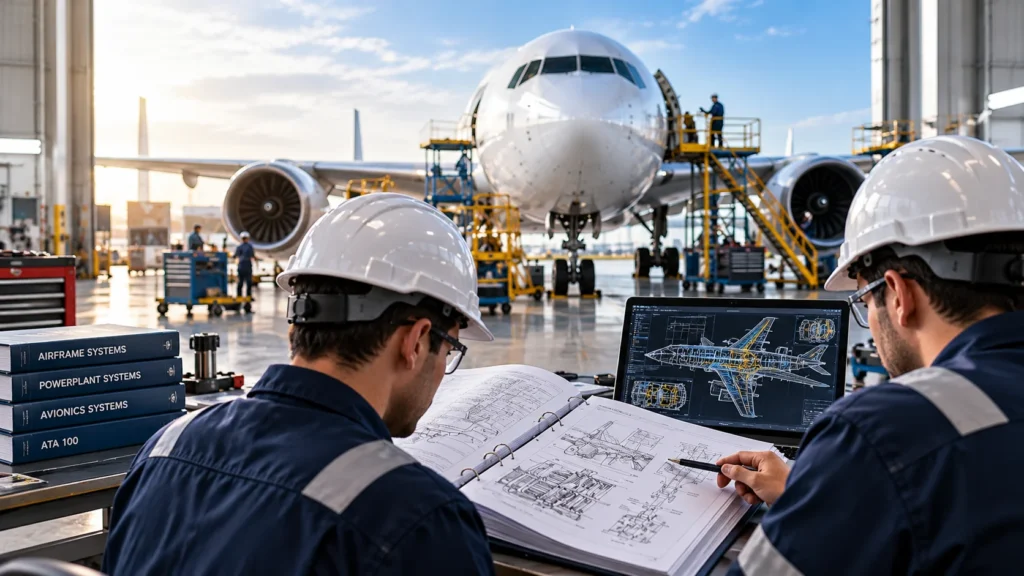
At its most basic level, an aircraft is a collection of systems that work together to achieve flight. These systems are divided into three main categories:
Airframe Systems
The airframe is the physical structure of the aircraft, the fuselage, wings, tail, and landing gear. But it’s more than just metal and rivets. Airframe systems include:
- Flight Controls: Ailerons, elevators, rudders, and the systems that move them
- Hydraulics: The power behind landing gear, flaps, and brakes
- Landing Gear: Retraction systems, steering, and braking
- Environmental Systems: Air conditioning, pressurization, and heating
- Structures: Understanding how the airframe transfers loads and resists stress
Powerplant Systems
The powerplant is what moves the aircraft forward or, in the case of helicopters, upward. Powerplant systems include:
- Engine Fundamentals: How turbines work, the combustion process, and thrust production
- Fuel Systems: Storage, delivery, and management of fuel
- Ignition Systems: Starting engines and maintaining combustion
- Exhaust Systems: Managing heat and emissions
- Lubrication: Oil systems and cooling
- Propellers: Converting engine power into thrust (for turboprop and piston aircraft)
Avionics and Electrical Systems
Modern aircraft are packed with electronics. Avionics and electrical systems include:
- Electrical Power: Generators, batteries, and distribution
- Instrumentation: Flight instruments, engine gauges, and warning systems
- Navigation: GPS, VOR, ILS, and the systems that keep you on course
- Communications: Radios, intercoms, and data links
- EWIS: The wiring that connects everything together
Industry Standard
The ATA 100 System: How Aircraft Systems Are Organized
If you’ve ever looked at an aircraft manual, you’ve probably seen references to ATA chapters. The ATA 100 numbering system is the industry standard for organizing aircraft technical information. Each chapter covers a specific system or component.
Here are some of the most common ATA chapters.
Our courses at GenFams are structured around the ATA 100 system, making it easy to find the information you need and build your knowledge chapter by chapter.
| ATA Chapter | System |
|---|---|
| 20 | Standard Practices (Airframe) |
| 21 | Air Conditioning & Pressurization |
| 22 | Autoflight |
| 24 | Electrical Power |
| 27 | Flight Controls |
| 28 | Fuel System |
| 29 | Hydraulic Power |
| 32 | Landing Gear |
| 49 | Auxiliary Power Unit (APU) |
| 51 | Structures |
| 61 | Propellers |
| 71 | Powerplant (General) |
| 72 | Engine (Turbine) |
| 73 | Engine Fuel & Control |
| 74 | Ignition |
| 79 | Oil System |
Getting Started
How to Learn Aircraft Systems
Learning aircraft systems doesn’t have to be overwhelming. Here’s a step-by-step approach:
Start with the Basics
Before you dive into specific systems, build a foundation. Learn the basic principles of flight: lift, weight, thrust, and drag. Understand the difference between an airframe and a powerplant. Get comfortable with basic terminology.
Our basic aviation courses online are designed to give you that foundation. We start with the fundamentals and build from there.
Focus on One System at a Time
Trying to learn everything at once is a recipe for frustration. Instead, pick one system, say, electrical power, and learn it thoroughly. Understand how it works, what components it includes, and how it interacts with other systems.
Once you understand one system, the next one will be easier.
Use Diagrams and Real-World Explanations
Aircraft systems are visual. You need to see how components connect and how fluid and electricity flow through the system. Our courses use diagrams and real-world explanations to bring the systems to life.
Test Your Knowledge
Learning is about retention, not just reading. Test yourself with quizzes, review questions, and practical applications. Our courses include section quizzes and final examinations to reinforce what you’ve learned.
Keep Learning
Aviation is constantly evolving. New aircraft, new systems, new technologies. The best professionals never stop learning. Our courses are regularly updated to reflect the latest aircraft technology and regulatory changes.
Who It’s For
Who Can Benefit from Aircraft Systems Training?
Aspiring Mechanics and Technicians
If you’re considering a career as an aircraft mechanic, understanding systems is the foundation of everything you’ll do. Our courses prepare you for the theoretical knowledge you’ll need for A&P certification.
Pilots
A pilot who understands aircraft systems is a safer pilot. Whether you’re flying a Cessna 172 or a Boeing 777, knowing how your aircraft works gives you confidence and insight that goes beyond the flight manual.
Engineers and Designers
If you’re designing aircraft systems or components, you need to understand how they fit into the larger picture. Our courses give you that context.
Enthusiasts and Career Changers
Aviation is a passion for many people, but it can also be a career. If you’re thinking about making the leap, our courses give you a taste of what’s involved and help you build the knowledge you need.
How GenFams Can Help You Learn Aircraft Systems
At GenFams, we specialize in general familiarization training. Our courses are designed to help you understand the systems of specific aircraft types from the Boeing 737 MAX to the Airbus A330, from the Bombardier Global 7500 to the Robinson R44.
Our courses include:
- ATA-Chapter Structured Content: Organized the way industry professionals organize it
- System Descriptions: Clear, concise explanations of how systems work
- Component Location Guides: Know where to find components on the aircraft
- Safety Precautions: Stay safe and compliant
- Section Quizzes: Test your knowledge as you go
- Final Examination: Confirm your understanding
All our courses are ATA-104 compliant and aligned with FAA ACS and EASA Part-66 standards. We take compliance seriously, because we know that the safety of the flying public depends on the quality of the training you receive.
Your Future
Career Paths in Aviation Maintenance
Learning aircraft systems is just the beginning. Here are some of the career paths you can pursue:
| Career Path | What You’ll Do | How to Get There |
|---|---|---|
| Aircraft Mechanic / Technician | Inspect, repair, and maintain aircraft | A&P license, Part 147 school |
| Avionics Technician | Work on aircraft electrical and electronic systems | Specialized training, A&P license |
| Inspector | Ensure maintenance meets regulatory standards | A&P license + experience |
| Engineer | Design and certify aircraft systems | Engineering degree + aviation experience |
| Quality Assurance | Oversee maintenance programs and compliance | A&P license + management experience |
| Military Transition | Leverage military training for civilian career | FAA certification + civilian training |
Ready to Get Started?
If you’re ready to learn about aircraft, you’ve come to the right place. Our basic aviation courses online are designed to help you build the knowledge you need for a successful aviation career.
Explore our courses, from the Boeing 737 MAX to the Airbus A330, from the Bombardier Global 7500 to the Robinson R44. Each course is structured around ATA chapters, includes system descriptions, component location guides, and safety precautions.
GenFams: Lift your knowledge. Lower your costs. Launch your future.