
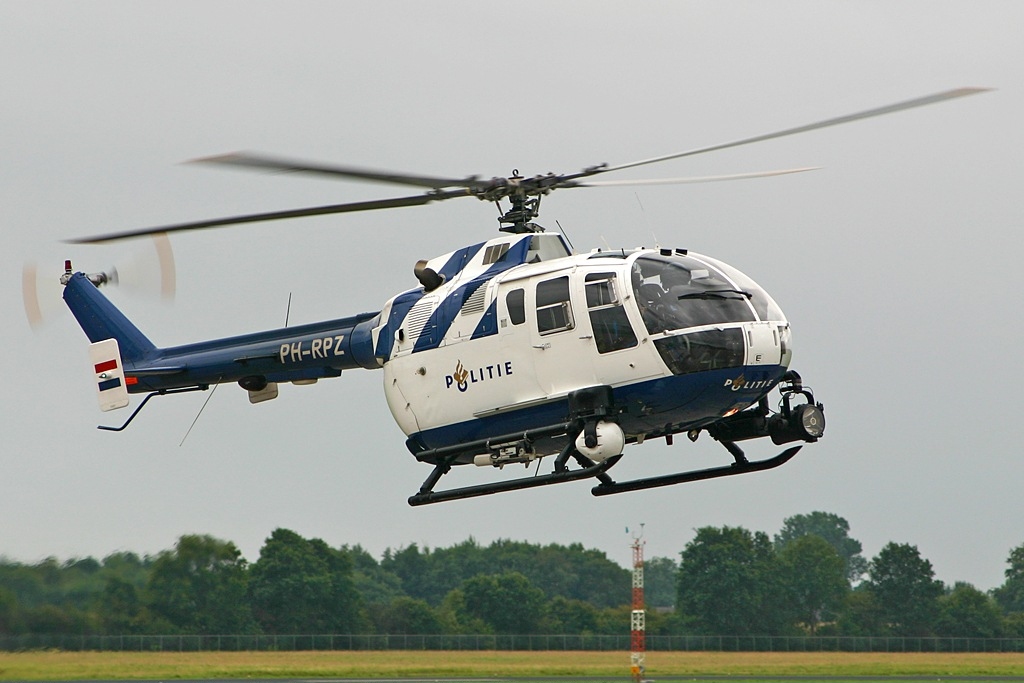
When the BO105 lifted off for its maiden flight on February 16, 1967, in Ottobrunn, Germany, it didn’t just introduce another helicopter. It introduced a revolution. The BO105 was the world’s first light twin-engine helicopter, and it was the first rotorcraft to feature a hingeless titanium main rotor with composite rotor blades. At a time when other helicopters relied on complex flapping and lead-lag hinges, the BO105’s rigid rotor system, known as the Bölkow rotor, drastically reduced moving parts, lowering maintenance costs and setting a new standard for agility and maneuverability.
But the BO105 didn’t just break new ground in engineering. It also redefined what a helicopter could do. It was the first rotorcraft capable of performing aerobatic man oeuvres such as inverted loops. This was proof of the extraordinary control and stability offered by its innovative rotor design.
The BO105 quickly proved its worth. Just three years after its first flight, in 1970, it was performing the world’s first helicopter emergency medical service (HEMS) missions. The first deliveries went to ADAC Air Rescue and the Bavarian Police, establishing a legacy in air rescue that continues to this day. From there, its reputation spread globally. By the time production ended in 2001, over 1,400 aircraft had been built in Germany, with a total of 1,640 produced worldwide including licensed manufacturing.
Why does this matter today? Because the BO105 is still flying, and it is still essential. As of 2026, the BO105 remains in service with eight air forces worldwide. In January 2026, a BO-105S was deployed for wildfire suppression in South Korea, carrying 1,000 litres of water. In April 2026, a Chilean Naval Aviation BO-105 performed an emergency landing after an engine failure. In July 2026, Carabineros de Chile was still operating the type, marking 50 years of service. And in August 2026, a Bolkow BO-105 Super Five arrived in Argentina to support rural crime operations. Even after more than five decades, this helicopter remains a trusted asset in missions that demand reliability.
Our BO105 gen fam course takes you inside this revolutionary helicopter. You will explore the airframe, the twin Allison 250-C20B turboshaft engines (420 shp each), the four-blade rigid main rotor system, and the two-blade tail rotor. The course covers the transmission, the skid landing gear, and the systems that keep this helicopter flying safely, from the hydraulics and electrical systems to the fuel system and avionics.
This BO105 helicopter systems training is aligned with FAA ACS (Airman Certification Standards), EASA Part-66 standards, and ATA-104 compliance requirements. Whether you are a mechanic maintaining a BO105 fleet, an engineer preparing for type rating, a pilot transitioning to rotary wing, or simply looking to expand your expertise, this course gives you the foundation you need.
The BO105’s rigid rotor system became the foundation for Airbus Helicopters’ modern rotorcraft, including the H135 and H145, which still benefit from its technological achievements. From the frontline of emergency medical services to military operations, wildfire suppression, and law enforcement, the BO105 has proven itself in nearly every arena. It is a helicopter that saves lives, supports critical infrastructure, and serves communities around the world. Mastering its systems is the first step to being part of that legacy.
Ready to master the rigid rotor pioneer? Reach out to us to learn more about our BO105 gen fam course.
Reviews
There are no reviews yet.